14 Schedule-I mammals in Karjat's study area
The project's own EC lists leopard, sloth bear, Indian wolf, four-horned antelope and pangolin among 14 Schedule-I mammals, and orders a human–animal conflict plan.
Every number on this site comes from a document I can point to:
Spotted a mistake, or have a document I should see? Write to daredavil239804@gmail.com with the page, the claim and, if you can, a source. I reply within 7 days and note every fix on the page.
Story
The trees, the species, the clearances, the villages and the case for the projects, in 10 short chapters. Every number links to its document. Pick a chapter, or start at the top. New to pumped storage? See how it works.
Chapter 1
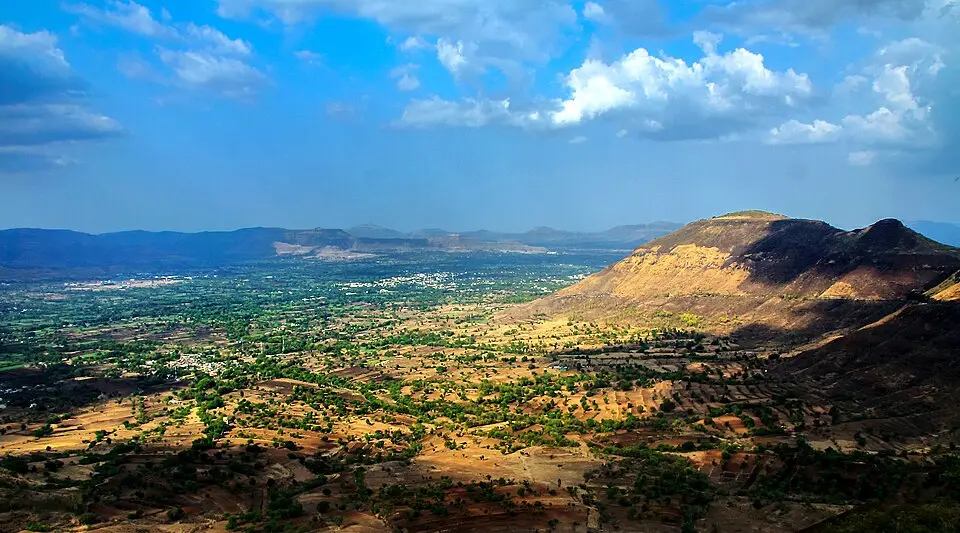
Above the village of Potal in Karjat taluka, the Sahyadri rises in a wall of forest towards the Saidongar plateau. On the forest committee's paper it is 233ⓘ hectares of forest land. On the ground it is a slope of trees, scrub and grass that turns green with the first rain, and the upper edge of a valley that six villages depend on.
Torrent Power wants to put a 3,000ⓘ MW pumped storage project here: two reservoirs, one on the plateau and one on the Pej river below, joined by tunnels. Water is pumped up when power is cheap and let down through turbines when it is dear. The project needs 377ⓘ hectares in all.
Nobody outside the Forest Department knows exactly. Three official numbers exist, and they do not agree.
FAC minutes, 2 Dec 2025 (Stage-I recommended)
Torrent's draft EIA (Aug 2025)
FPJ (citing TOI)
| Source | Trees |
|---|---|
| FAC minutes, 2 Dec 2025 (Stage-I recommended) | 48,557 |
| Torrent's draft EIA (Aug 2025) | 48,000 |
| FPJ (citing TOI) | 32,490 |
No public document explains why the permission covers so many fewer trees than the committee counted. A phased approval is one possible reason; I have not been able to confirm it.
Activists say even the highest figure is too low. Adv. Kailash More of the Karjat Taluka Paryavaran Bachao Samiti told ThePrint that the number actually being cut is several times what is on paper. Alleged No survey has tested that claim, and none is public.
I show these numbers side by side, and do not average them.
The same committee minutes record that 197.77ⓘ of the 233ⓘ hectares lie inside the proposed Rajmachi Conservation Reserve, and inside the Western Ghats ESA in the draft of July 2024. Documented Neither has been notified. The committee recommended Stage-I clearance anyway, and told the developer to seek approval again if the reserve is ever notified. The ministry granted Stage-I on 31 December 2025, and the EC followed on 12 January 2026.
The forest that is lost is to be "compensated" with 252.76ⓘ hectares at Kemase and Dhankal in Patan taluka of Satara, after the first site fell through. That land is already forest-like, and it sits in the buffer of Sahyadri Tiger Reserve. Documented Compensatory afforestation there plants trees among trees, a district away.
Felling began around Dussehra. On 26 October, at a press conference in Mumbai with actor Sayaji Shinde, Adv. More alleged that hundreds of trees were coming down every day. Alleged Aaditya Thackeray visited Saidongar and called it a "massacre of nature". Reported Chief Minister Devendra Fadnavis said the project had completed all approvals and that local concerns would be considered. Official claim
On 27 October the Forest Department said felling had stopped. Reported It has not said how many trees were already cut, or whether the halt is formal. Prime Minister Narendra Modi is scheduled to lay the foundation stone on 3 November.
Karjat is the project where trees are falling first, not the only one where they will fall. The committee papers for Tata Power's Shirawta project record 64,729ⓘ trees, on forest with a canopy density of 0.7ⓘ, which the forest survey classes as very dense. Documented Adani's Malshej Ghat project at Bhorande counts about 35,000ⓘ trees, Torrent's second project at Maval 9,554ⓘ, and Tata's Bhivpuri 6,834ⓘ.
Together, the projects that have published a tree count add up to 1,64,674 trees on record. Most projects in the pipeline have not published one at all.
The forest committee that cleared Karjat recorded 48,557 treesDocumented“Also, the proposal involves felling of 48557 number of trees.”FAC minutes, 2 Dec 2025 (Saidongar-1 Stage-I), page177 · 2 December 2025 to be felled on 233 haDocumented“…te Change to review the project’s environmental implications. The organisation has raised concerns over the proposed diversion of 233 hectares of forest land, warning of potential impacts on the Saidongar area’s natural resources, wildlife and local communities.…”FPJ (citing TOI): felling permission of 14 Oct 2026 · 25 October 2026; Torrent's own draft EIA said 'about 48,000Documented“clearing of 48,000 nos. of trees. (Trees proposed for plantation on Muck disposal area also”Saidongar-1 draft EIA executive summary (MPCB), page21 · August 2025'. The felling permission reported in Oct 2026 is for 32,490Documented“…Pawar Oppose Cutting Of 32,490 Trees For Karjat Power Project A forest order dated October 14, 2026, reportedly permits felling 32,490 trees in Karjat forests for Torrent Power’s proposed 3,000 MW Saidongar-I project. Commenting on the opposition criticism, state…”FPJ (citing TOI): felling permission of 14 Oct 2026 · 25 October 2026.
Documented Source: FAC minutes, 2 Dec 2025 (Saidongar-1 Stage-I) · FPJ (citing TOI): felling permission of 14 Oct 2026 · Saidongar-1 draft EIA executive summary (MPCB)
Chapter 2
A tree count is the easiest thing to measure and the least of what is lost. The Sahyadri is not a stand of trees. It is a living system of forest, plateau, river and grove, and these projects cut into all four.
Torrent says the Karjat site is 16ⓘ km from Bhimashankar Wildlife Sanctuary and outside its eco-sensitive zone. Official claim On a map of legal boundaries, that is true. On a map of where animals move, it is not the point.
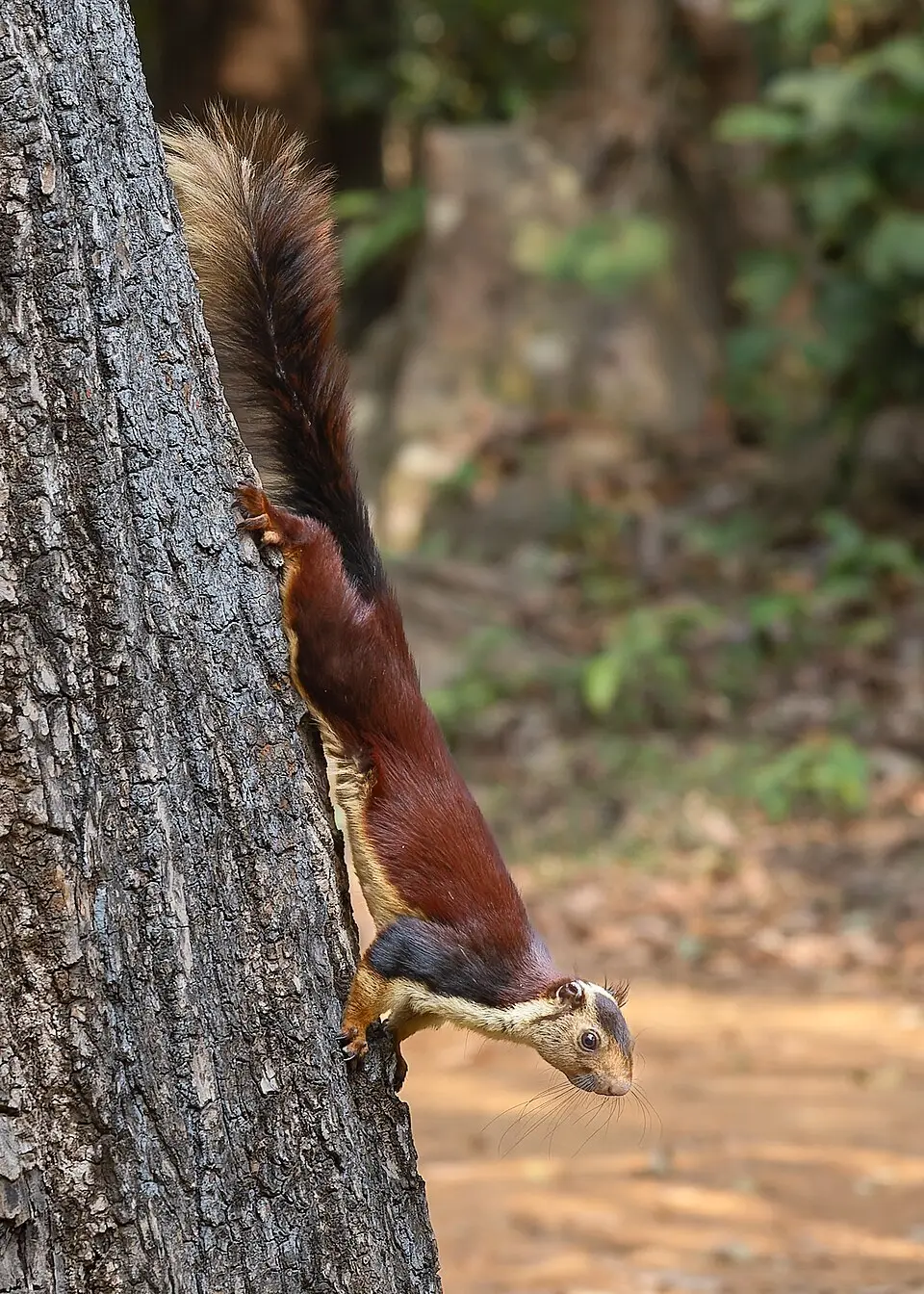
Karjat lies on the forest belt that links Bhimashankar to Malshej Ghat and on to the rest of the northern Sahyadri. Reported Leopard, sambar, gaur, langur and the Shekru, the Indian giant squirrel that is Maharashtra's state animal, use this belt. The Shekru lives in the canopy and travels from tree to tree; a reservoir or a cleared transmission line is a wall to it.
The project's own EC lists 14ⓘ Schedule-I mammals in its study area, including leopard, sloth bear, Indian wolf, four-horned antelope and pangolin, and orders a plan for human–animal conflict. Documented Schedule-I is the highest protection Indian wildlife law gives. A project that needs a conflict plan for its neighbours is not far from wildlife.
Further north, THDC's Malshej project is about 3ⓘ km from Kalsubai-Harishchandragad Wildlife Sanctuary, and its upper reservoir at Khubi sits on the corridor between Harishchandragad and Bhimashankar. Reported To the south, Adani's Nivakane project is about 150ⓘ metres from the buffer of Sahyadri Tiger Reserve. Documented
Sanctuary or national park boundaryEco-sensitive zone (dashed: proposed) Pumped storage project
| Project | Nearest protected area | km |
|---|---|---|
| Ghatghar PSP Stage II | Kalsubai-Harishchandragad WLS | 0 |
| Koyna–Nivakane PSP | Sahyadri Tiger Reserve (buffer zone) | 0.2 |
| THDC Malshej Ghat PSP | Kalsubai-Harishchandragad WLS | 3 |
| Humbarli Birmani PSP | Koyna WLS (Sahyadri Tiger Reserve core) | 8.8 |
| Malshej Ghat Bhorande PSP | Bhimashankar Wildlife Sanctuary | 10.8 |
| Saidongar-2 PSP, Maval | Bhimashankar Wildlife Sanctuary | 14.5 |
| Saidongar-1 PSP, Karjat | Bhimashankar Wildlife Sanctuary | 15.5 |
| Ambegaon PSP | Bhimashankar Wildlife Sanctuary | 16 |
| Shirawta PSP | Bhimashankar Wildlife Sanctuary | 19.7 |
Upper reservoirs need flat ground at the top of a cliff. In the Sahyadri, that means the lateritic plateaus, the sada. For most of the year they look bare. In the monsoon they flower.
The Naneghat plateau, next to Adoshi where Adani plans Bhorande's upper reservoir, holds 45ⓘ plant taxa found only in India. Adoshi and Ajnawale hold six threatened endemics, including the quillwort Isoetes dixitei. Reported On the Kas plateau, about 80ⓘ% of the region's significant plant species grow only on the plateau top and its cliffs. Documented
Because plateaus are often classed as "non-forest", their loss does not show up in the forest figures in Chapter 3.
Maharashtra has thousands of devrai, groves protected by villages for their deity. One study counts about 2,800ⓘ. Reported Many hold the oldest trees left in their valley. The Adrai devrai near Khubi shelters Ceropegia anantii, a plant listed as Critically Endangered, and three other Ceropegia species grow about 200ⓘ metres from Adoshi. Reported No clearance paper we have read maps the devrai inside a project area.
The Kalu, below Malshej, is one of the last west-flowing rivers in the region without a dam. About half its watershed is dense forest, and it sustains the Katkari, a Particularly Vulnerable Tribal Group. The Supreme Court has stayed a dam on it. Reported Bhorande would lift water from the Kalu to a reservoir near the Kukadi basin on the other side of the crest.
Karjat, Bhivpuri, Shirawta and Warasgaon are open-loop designs: one of their reservoirs sits on a river, and the river's fish, flow and floods become part of the machine. Documented
Citizen scientists in Murbad taluka alone have logged more than 5,500ⓘ observations of over 1,600ⓘ species, including the rusty-spotted cat, striped hyena and Malabar trogon. Reported None of them is in an EIA.
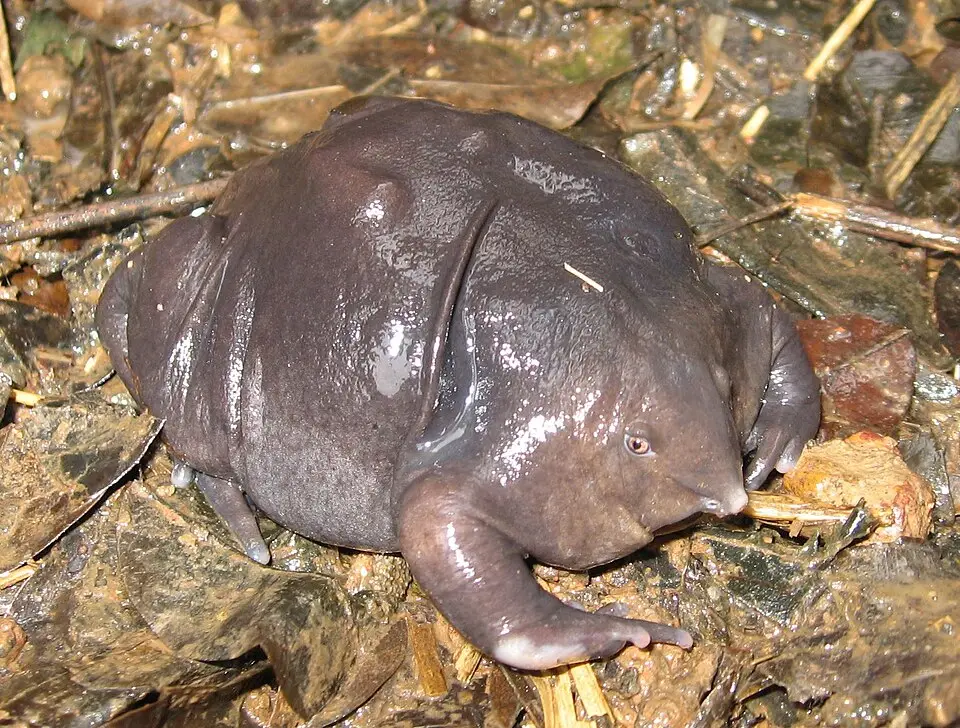

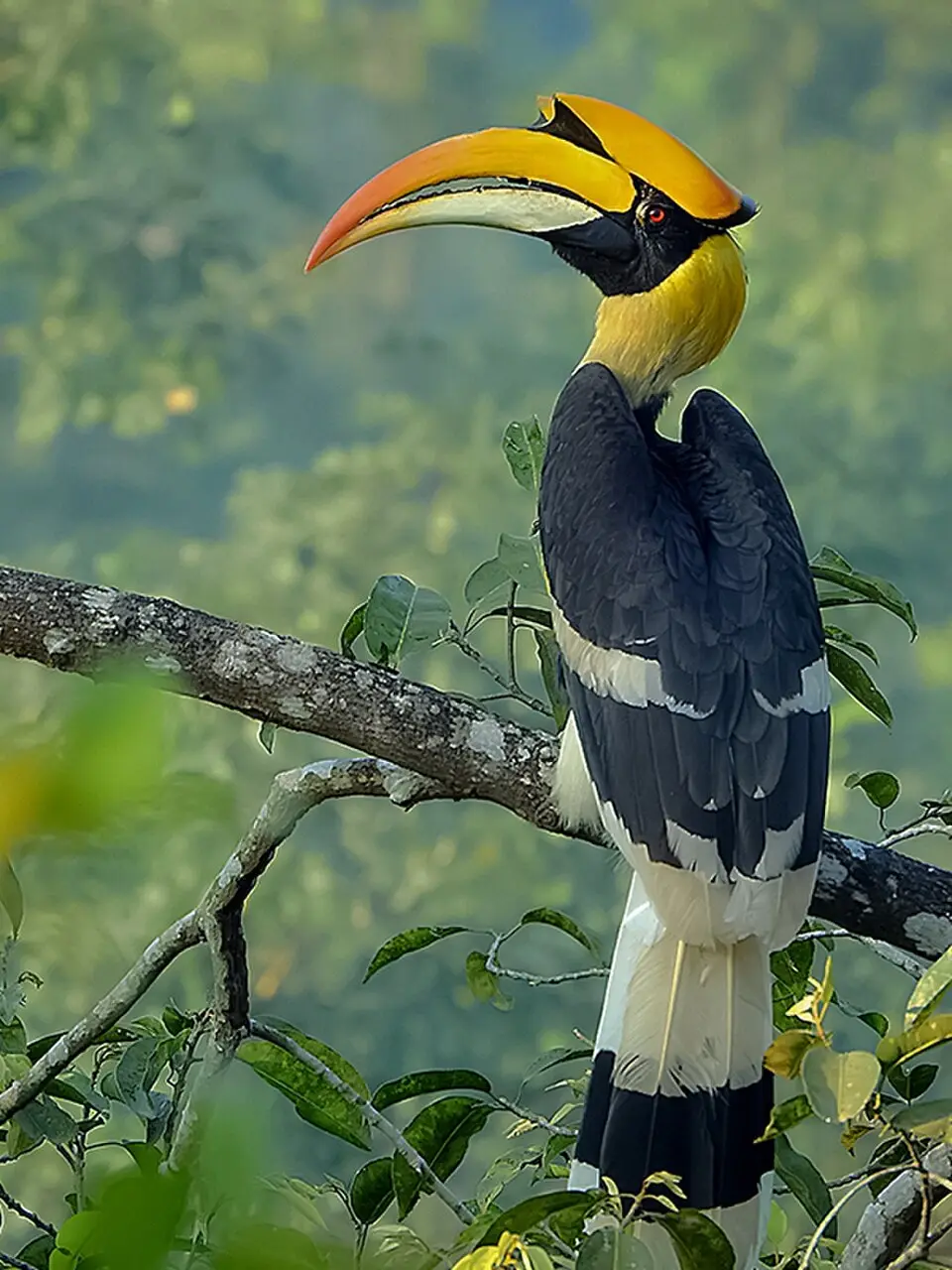
The project's own EC lists leopard, sloth bear, Indian wolf, four-horned antelope and pangolin among 14 Schedule-I mammals, and orders a human–animal conflict plan.
A contiguous forest linkage used by leopard, sambar, gaur, Shekru and langur. Karjat lies within it even though it is outside the sanctuary's legal line.
Lives in Bhimashankar's canopy near Karjat. Canopy fragmentation from submergence and transmission lines cuts its tree-to-tree routes.
Naneghat holds 45 Indian endemic plant taxa; Adoshi and Ajnawale plateaus hold six threatened endemics including Isoetes dixitei. Bhorande's upper reservoir is planned on Adoshi.
A devrai near Khubi shelters the Critically Endangered Ceropegia anantii; three Ceropegia species grow ~200 m from Adoshi.
One of the region's last free-flowing west-flowing rivers; about half its watershed is dense forest. It sustains the Katkari, a Particularly Vulnerable Tribal Group. The Supreme Court has stayed a dam on it.
Khubi, site of THDC's upper reservoir, links two wildlife sanctuaries; flamingos, leopard, sambar and barking deer recorded.
THDC's Malshej PSP is 3 km away.
Citizen scientists have logged 5,500+ observations of 1,600+ species, including rusty-spotted cat, striped hyena, leopard and Malabar trogon.
Western Ghats PSPs threaten sacred groves, sacred river origins and community-protected fish pools.
Karjat alone will excavate 110.78 lakh m³ of rock and dump 65.69 lakh m³ at three sites, on slopes where its EC requires landslide prevention. Raigad has seen deadly landslides (Taliye 2021, Irshalwadi 2023).
A systematic review found PSP construction causes habitat loss, invasive plants, altered hydrology and poorer water quality.
Building a pumped storage plant means tunnelling through a mountain. Karjat alone will excavate 110.78ⓘ lakh cubic metres of rock and dump 65.69ⓘ lakh cubic metres of it as muck at three sites, on slopes where its own EC demands landslide prevention. Documented Raigad district remembers Taliye in 2021 and Irshalwadi in 2023, where hillsides came down on villages.
The Western Ghats are home to at least 325ⓘ globally threatened species. Documented The question this chapter leaves is simple: what does a "9.6 hectares per GWh" figure measure, when what is lost is a corridor, a plateau, a grove and a river?
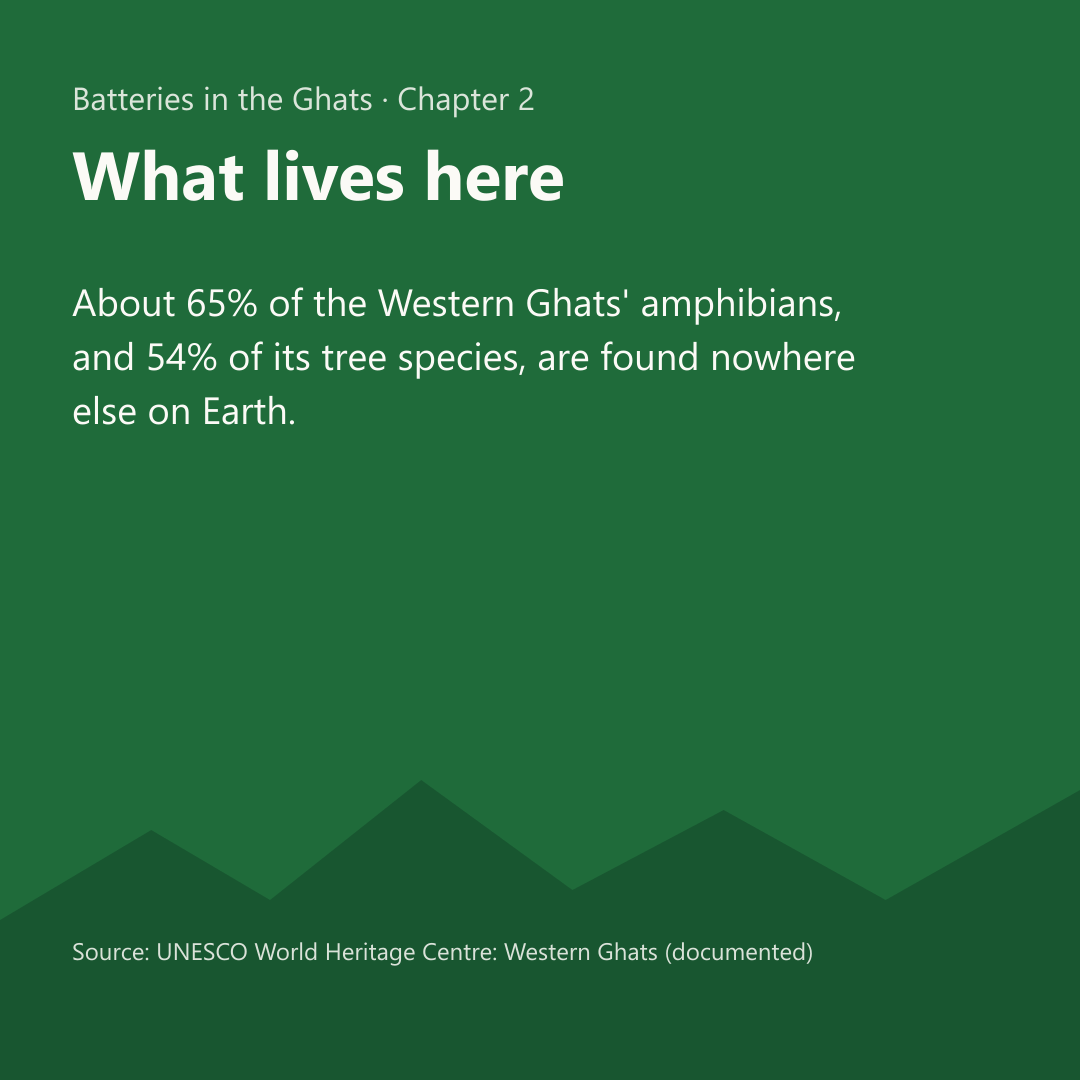
About 65%Documented“…cies found in the Western Ghats, 352 (54%) are endemic. Animal diversity is also exceptional, with amphibians (up to 179 species, 65% endemic), reptiles (157 species, 62% endemic), and fishes (219 species, 53% endemic).…”UNESCO World Heritage Centre: Western Ghats of the Western Ghats' amphibians, and 54%Documented“…of the 4-5,000 plant species recorded in the Ghats is very high: of the nearly 650 tree species found in the Western Ghats, 352 (54%) are endemic. Animal diversity is also exceptional, with amphibians (up to 179 species, 65% endemic), reptiles (157 species, 62%…”UNESCO World Heritage Centre: Western Ghats of its tree species, are found nowhere else on Earth.
Documented Source: UNESCO World Heritage Centre: Western Ghats
Chapter 3
Every pumped storage project in the Ghats arrives with a bill paid in land. Some of it is farmland bought from families. Much of it is forest.
14 projects in the Western Ghats have published both how much forest they need and how much energy they store. Together they need 1,331.2 hectares of forest for 139.1 GWh of storage. Documented
The largest project proposed in the state, JSW's 5,400ⓘ MW scheme in Bhor and Mahad, needs 645.62ⓘ ha, of which 241.22ⓘ ha is forest. Documented
Bhavali PSP
243.7 ha
Saidongar-1 PSP, Karjat
233 ha
Shirawta PSP
160.8 ha
Aruna Kolamb PSP
128.9 ha
Amba PSP
112.6 ha
Aruna PSP
73.6 ha
Pane PSP
66.9 ha
Malshej Ghat Bhorande PSP
60.9 ha
Savitri PSP
55.6 ha
Humbarli Birmani PSP
49.5 ha
Saidongar-2 PSP, Maval
35.6 ha
Bhivpuri PSP
20.1 ha
| Project | Forest (ha) | Trees |
|---|---|---|
| Bhavali PSP | 243.7 | – |
| Saidongar-1 PSP, Karjat | 233 | 48,557 |
| Shirawta PSP | 160.8 | 64,729 |
| Aruna Kolamb PSP | 128.9 | – |
| Amba PSP | 112.6 | – |
| Warasgaon–Warangi PSP | 90 | – |
| Aruna PSP | 73.6 | – |
| Pane PSP | 66.9 | – |
| Malshej Ghat Bhorande PSP | 60.9 | 35,000 |
| Savitri PSP | 55.6 | – |
| Humbarli Birmani PSP | 49.5 | – |
| Saidongar-2 PSP, Maval | 35.6 | 9,554 |
| Bhivpuri PSP | 20.1 | 6,834 |
To compare projects of different sizes, I divide forest by storage. Across the 14 projects, the average is 9.6 hectares of forest per GWh. The methodology shows the formula and every input.
The spread matters more than the average. Adani's Tarali project in Satara needed forest at first and was redesigned to use 0ⓘ ha. Tata's Bhivpuri needs only 20.14ⓘ ha. Siting is a choice, and it changes the forest bill many times over.
ha of forest per GWh of storage
| Project | Forest (ha) | GWh | ha of forest per GWh of storage |
|---|---|---|---|
| Bhavali PSP | 243.7 | 11 | 22.1 |
| Aruna Kolamb PSP | 128.9 | 7.4 | 17.5 |
| Shirawta PSP | 160.8 | 10.8 | 14.9 |
| Saidongar-1 PSP, Karjat | 233 | 17.1 | 13.6 |
| Amba PSP | 112.6 | 8.9 | 12.6 |
| Warasgaon–Warangi PSP | 90 | 9 | 10 |
| Aruna PSP | 73.6 | 9 | 8.2 |
| Pane PSP | 66.9 | 9.6 | 7 |
| Malshej Ghat Bhorande PSP | 60.9 | 9 | 6.8 |
| Humbarli Birmani PSP | 49.5 | 9.3 | 5.3 |
| Saidongar-2 PSP, Maval | 35.6 | 7.2 | 4.9 |
| Savitri PSP | 55.6 | 15.1 | 3.7 |
| Bhivpuri PSP | 20.1 | 6 | 3.4 |
| Tarali PSP | 0 | 9.8 | 0 |
Maharashtra has signed MoUs for 78,215 MW. At 6 hours each, that is about 469 GWh. At the average above, it would need roughly 4,500 hectares of forest. This is an illustration of scale, not a forecast: many MoUs will never be built, and better siting would lower it.
Paper figures tend to grow. When forest officers inspected MEIL's Ghosla site, its forest land went from 29.5ⓘ ha to 65.35ⓘ ha. Documented Warasgaon's went from 24.5ⓘ to 88.98ⓘ ha between applications. Documented
And the bill counts only land legally classed as forest. It leaves out:
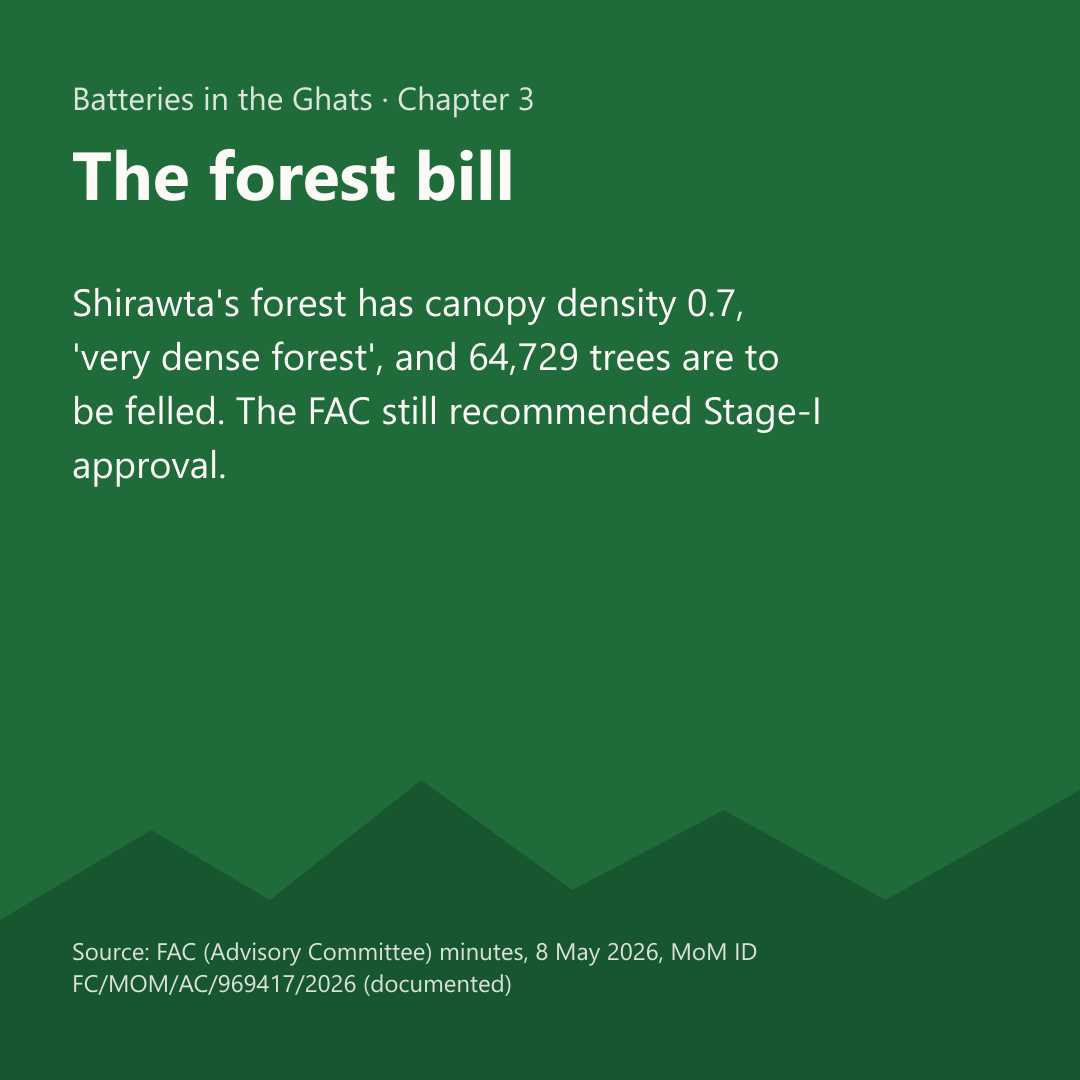
Shirawta's forest has canopy density 0.7Documented“0.7 (Very Dense Forest) of Eco Class I and 64729 number of trees are”FAC (Advisory Committee) minutes, 8 May 2026, MoM ID FC/MOM/AC/969417/2026, page92 · 8 May 2026, 'very dense forest', and 64,729 treesDocumented“0.7 (Very Dense Forest) of Eco Class I and 64729 number of trees are”FAC (Advisory Committee) minutes, 8 May 2026, MoM ID FC/MOM/AC/969417/2026, page92 · 8 May 2026 are to be felled. The FAC still recommended Stage-I approval.
Documented Source: FAC (Advisory Committee) minutes, 8 May 2026, MoM ID FC/MOM/AC/969417/2026
Chapter 4
India's rules for a project like this are long. A developer needs a ToR, an EIA, a public hearing, an environmental clearance (EC) from the Expert Appraisal Committee, forest clearance in two stages, and the consent of forest-dwelling communities. Each step is meant to be a chance to say no, or to say "not here".
None of the steps below is illegal on its own. Together, they turn a review into a formality. Every item links to the document it comes from on the shortcuts page.
Resettlement "not applicable". The 2013 land acquisition law requires a rehabilitation plan for affected families. Karjat's draft EIA says no plan is needed, citing a 2014 Maharashtra notification that applies R&R only to private purchases of 1,000ⓘ hectares or more. The project needs 377ⓘ hectares. Documented
Outside the line, inside the habitat. Wildlife clearance and stricter scrutiny apply near protected areas. Karjat is described as 16ⓘ km from Bhimashankar and outside its eco-sensitive zone, so it needed no wildlife clearance. Its own EC lists 14ⓘ Schedule-I mammals in the study area. Documented
A reserve that is only "proposed". The forest committee found most of Karjat's forest inside the proposed Rajmachi Conservation Reserve and cleared it because the reserve is not yet notified (Chapter 1). Documented The Western Ghats ESA, which would also cover Karjat, has been issued in draft six times since 2014 and never made final. Reported The Gadgil panel wanted 64ⓘ% of the Western Ghats treated as ecologically sensitive; the Kasturirangan group cut it to 37ⓘ%. Reported A protection that stays a draft protects nothing.
Adani's Warasgaon–Warangi was rejected by the EAC on 27 September 2024 after its forest need more than tripled. A fresh ToR was granted on 31 December 2024. Documented Rejection was a delay, not a no.
Experts say the EAC almost never rejects a project. Himanshu Thakkar of SANDRP calls its rejection rate "practically zero" and says it does no assessment of options. Reported
The ToR conditions for THDC's Humbarli Birmani ask for Stage-I clearance of 55.64ⓘ ha of forest. That is the Savitri project's figure; Humbarli needs 49.5ⓘ ha. Documented The EAC visited NTPC's Amba site in June, before the rains, saw cactus and dry streams, and concluded the reservoirs "will enhance moisture content". Documented
No cumulative impact study exists for the Kal, Savitri, Pej, Kalu or Koyna basins. Documented Each project is assessed alone, as if the next valley were empty. Pane's upper dam is about 3ⓘ km from Warasgaon's. The upper reservoirs of NTPC's Amba and Avaada's Pawana Falyan, appraised separately, are about 1.5ⓘ km apart. Documented
Drilling as "forest activity". The Forest Advisory Committee recommended in July 2024 that exploratory drilling for hydro and pumped storage be treated as forest activity, needing no clearance, with felling of up to 100ⓘ trees. Documented Whether it has been notified is not confirmed.
Loosening the limits. The Central Electricity Authority's roadmap of January 2026 proposes allowing pumped storage in eco-sensitive zones that are not yet notified and within 10ⓘ km of protected areas, a lighter "White Category" for off-river projects, and relaxed Western Ghats conditions. Documented These are proposals, not law.
Fast-track from the top. In November 2025 the Chief Minister promised a "fast-track mechanism" for time-bound clearances, environmental approvals included. In March 2026 he ordered time-bound rollout of all 55ⓘ MoUs. Official claim The approvals were promised before the assessments were done.
A green label. Pumped storage is classed as renewable energy. That brings green certificates, priority lending and transmission waivers, without counting the forest carbon lost or checking what power is used to pump the water (Chapter 7). Documented
The 2013 land acquisition law (RFCTLARR) requires a rehabilitation and resettlement plan for affected families.
Resettlement declared 'not applicable' Documented
Documents ↗
Wildlife clearance and stricter scrutiny apply to projects near protected areas.
Outside the sanctuary line, inside the habitat Documented
Documents ↗
Rejection by the Expert Appraisal Committee should force a lower-impact redesign.
Rejected in September, back in December Documented
Documents ↗
Cumulative impact and carrying-capacity studies show what many projects do to one basin together.
Project by project, never the valley Documented
Documents ↗
Eco-sensitive zones, the 10 km buffer around protected areas, and Western Ghats conditions limit where projects can go.
Proposal to loosen the rules themselves Documented
Documents ↗
Any non-forest use of forest land needs prior clearance under the Forest (Conservation) Act.
Drilling redefined as 'forest activity' Documented
Documents ↗
Environmental and water approvals are meant to be independent assessments.
Fast-track promised before the projects are assessed Official claim
Documents ↗
Green incentives should reward net environmental benefit.
A 'green' label that ignores the forest Documented
Documents ↗
No construction before environmental and forest clearance and a public hearing.
Works on the ground before clearance (alleged) AllegedNot yet reviewed
Documents ↗
An EIA must survey the actual site's species and river.
Baseline data from the wrong river ReportedNot yet reviewed
Documents ↗
Tree enumeration fixes the compensation and the scale of felling.
Three different tree counts Reported
Documents ↗
Unused acquired land should revert to owners under the 2013 Act.
Land taken for one dam, reused for another (alleged) AllegedNot yet reviewed
Documents ↗
The EAC should independently test projects, including whether they are needed.
A regulator that 'practically' never says no Reported
Documents ↗
Activists have said the EAC skipped site visits before granting ECs. In September 2024 the EAC said a site visit would be carried out "wherever possible" for the 15ⓘ projects proposed in the Western Ghats. I checked the minutes: visits to Bhivpuri, Shirawta, Karjat and Pane are on record before their ECs. We mark that claim as not supported and keep it in the data with the reason. Whether a visit was enough is another question: at Karjat, the sub-committee judged the upper reservoir from the developer's drone footage, because it could not reach the site. Documented
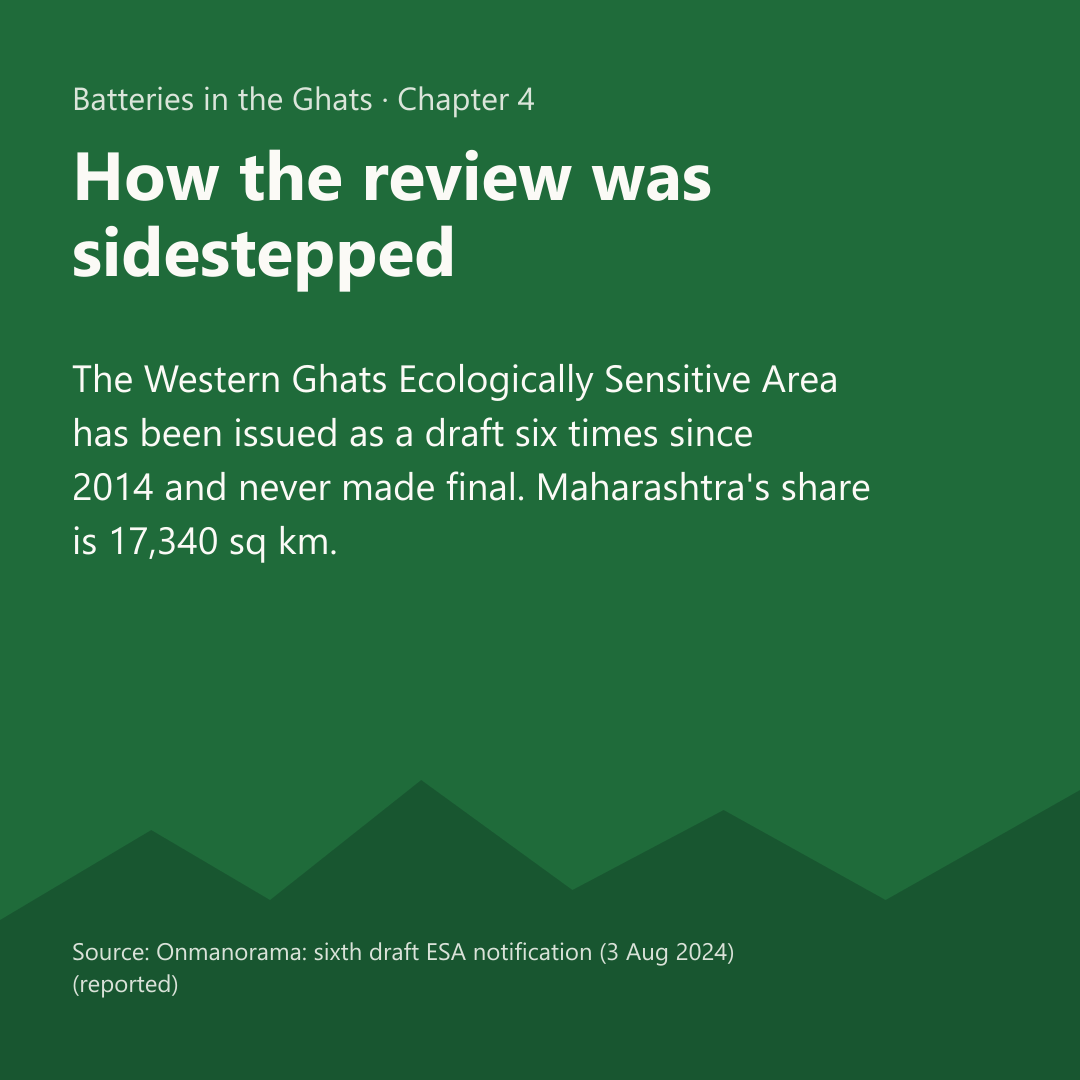
The Western Ghats Ecologically Sensitive Area has been issued as a draft six times since 2014 and never made final. Maharashtra's share is 17,340Reported“Overall, the notification proposes to declare 56,825.7 sq km as ecologically sensitive, including 449 sq km in Gujarat, 17,340 sq km in Maharashtra, 1,461 sq km in Goa, 20,668 sq km in Karnataka, 6,914 sq km in Tamil Nadu, and 9,993.7 sq km in Kerala.”Onmanorama: sixth draft ESA notification (3 Aug 2024) sq km.
Reported Source: Onmanorama: sixth draft ESA notification (3 Aug 2024)
Chapter 6
Why so many projects, so fast? Because Maharashtra has promised a great deal of storage.
By March 2026 the state had signed about 55ⓘ MoUs for 78,215ⓘ MW of pumped storage. Official claim The Chief Minister said six of them, 10,300ⓘ MW in all, had their project reports approved by the Central Electricity Authority. Official claim
Today about 400ⓘ MW actually runs in the state: Bhira (150ⓘ MW) and Ghatghar (250ⓘ MW). Documented
Operating (2)Cleared or being built (6)MoU or ToR stage (22)Deferred, lapsed or rejected (4)
This site tracks 39 projects with 60,615 MW between them, 50,815 MW of it in the Western Ghats. Most are at an early stage: 23 have a ToR, which lets them start their EIA. A handful have an EC or forest clearance. One, Karjat, has started cutting. The projects page lists every one, sorted by trees and forest first.
An MoU is a promise, not a permit. But in this pipeline the promise has a way of arriving before the review. Rithwik's 1,200ⓘ MW Chandgad project got its ToR recommendation in March 2023, more than two years before the state signed its MoU. Documented And because the projects are reviewed one at a time (Chapter 4), nobody has asked how many of them the Sahyadri can hold.
Maharashtra has signed about 55Documented“Maharashtra Pumped Storage Power Projects: 55 MoUs Fast-Tracked”Electrical Mirror: ensure fast implementation of 55 MoUs, page55 · 13 April 2026 PSP MoUs for 78,215 MWDocumented“…eting, Maharashtra has signed 55 MoUs with various companies to develop pumped storage projects with a total proposed capacity of 78,215 MW. The projects are expected to attract an investment of around ₹4,16,701 crore and generate nearly 1,27,990 employment opportun…”Electrical Mirror: CM review of 55 PSP MoUs. Only about 400 MWDocumentedDerived on this siteBhira 150 MW + Ghatghar 250 MW.Wikipedia: Bhira Hydroelectric Project (150 MW pumped storage unit) actually runs today: Bhira (150 MWDocumented“…Specifications [ edit ] The plant's maximum output capacity is nominally 300 MW , generated by six 25 MW Pelton turbines and a 150 MW pumped storage generator added in 1997. In 2014 two 10 kW microturbine units were added to generate further power from the t…”Wikipedia: Bhira Hydroelectric Project (150 MW pumped storage unit)) and Ghatghar (250 MWDocumented“dated 10.06.1985 to the existing project Ghatghar 2x125MW PSP. The committee”2 × 125 MW = 250 MW.EAC 52nd meeting minutes, 13 Apr 2026, page4 · 13 April 2026).
Documented Source: Wikipedia: Bhira Hydroelectric Project (150 MW pumped storage unit) · EAC 52nd meeting minutes, 13 Apr 2026: existing Ghatghar 2x125 MW PSP · CEA: PSP development in country (Jun 2024) · Electrical Mirror: CM review of 55 PSP MoUs
Chapter 7
A pumped storage plant does not make electricity. It stores it, and it loses some along the way.
When solar floods the grid at midday, pumps push water from the lower reservoir up a tunnel to the upper one. The hill becomes a battery.
When demand peaks, the water falls back through turbines and makes electricity. About 22% of the energy is lost on the round trip.
Two reservoirs, a dam, tunnels, muck dumps, roads and power lines go onto forested hills. On record so far: 1,64,674 trees to be felled, from the 5 projects whose tree count is public, and 3,211 ha of forest land across 32 of the 39 projects.
Reservoirs and roads break up plateaus, streams and wildlife corridors that hold species found nowhere else, and take village land and grazing.
Every unit used to pump water uphill returns about 77.5% when the water comes down. Documented That is the round-trip efficiency in Tamil Nadu's 2026 tariff order, the best contractual figure in India. The rest is lost to friction, pumps and turbines.
If the projects tracked here ran at the rate Karjat's EC expects, they would deliver about 162 TWh a year and lose about 47 TWh a year doing it. That is about 2.7% of everything India generated in FY2025-26. This is a model, not a measurement; the methodology shows how.
Storage moves emissions in time. Whether it cuts or adds CO₂ depends on which power plants run more when it pumps, and which run less when it generates.
On today's grid the plants that change output first are mostly coal. If coal pumps the water and the stored power displaces coal later, every MWh delivered adds about 0.28 tonnes of CO₂, because of the loss. Across the pipeline that is up to 45 million tonnes a year. This is an upper bound, not a forecast.
If instead the pump uses solar power that would otherwise be wasted, storage cuts emissions, by about -0.88 tonnes per MWh once the plant's own construction is counted. That is the case for storage, and it is a real one.
The break-even is simple: storage cuts emissions only when more than 22.5% of the pumping energy is solar that would otherwise be thrown away, or 29.4% once construction is counted.
Break-even solar share: 22.5%
Developers state the CO₂ their projects will "avoid". Official claim Those claims assume every unit of pumping power is clean. No project I have read commits to publishing what time of day it pumps, or from what. Without that, nobody can say whether a given plant is a solar battery or a coal battery. And none of the "avoided" figures subtracts the forest carbon lost in Chapters 1 to 3.
A pumped storage project uses more electricity than it gives back. At 77.5%DocumentedDerived on this site“In its order dated April 30, the commission adopted a tariff discovered through competitive bidding, fixing an annual fixed charge of Rs 123 lakh per MW with a declared cycle loss of 22.5%, resulting in a total annual storage cost of Rs 150.675 lakh per MW.”100% − 22.5% cycle loss = 77.5% round-trip efficiency.DT Next: TNERC approves tariff for 500 MW pumped storage round-trip efficiency, 22.5Documented“In its order dated April 30, the commission adopted a tariff discovered through competitive bidding, fixing an annual fixed charge of Rs 123 lakh per MW with a declared cycle loss of 22.5%, resulting in a total annual storage cost of Rs 150.675 lakh per MW.”TNERC PSP tariff order 2026 (22.5% cycle loss) of every 100 units used for pumping are lost.
Documented Source: TNERC PSP tariff order 2026 (22.5% cycle loss) · NREL ATB 2023: round-trip efficiency 70–87%
Chapter 8
A pumped storage plant only helps if it pumps. Gujarat's 240ⓘ MW Kadana ran a pump-mode trial in 2004–05 and has not pumped since. Sardar Sarovar's 1,200ⓘ MW has never pumped at all. Documented Both are still counted as pumped storage in national plans.
Big tunnels in hard mountains run late and over budget. Australia's Snowy 2.0, first priced in 2017, now has a target cost of A$22.2ⓘ billion plus contingency, up to A$25ⓘ billion: more than 12ⓘ times that first estimate. Reported The Western Ghats are geologically different, but the lesson about underground risk travels.
A$ billion
| First estimate, 2017 | 2 |
| Target cost, Oct 2026 | 22.2 |
| With contingency | 25 |
Battery prices have fallen fast. Put on the same basis, rupees per MWh of storage capacity per year, recent Indian tenders give ₹8.6–14.3 lakh for battery storage and ₹9.7–13.6 lakh for pumped storage. Documented The ranges overlap. Batteries sit on a few hectares of already-cleared land, are built in months rather than years, and can go next to the solar parks they serve.
A tariff is a price, not the full cost, and batteries and eight-hour pumped storage do somewhat different jobs. The methodology lists every tender and its limits.
₹ lakh per MWh of storage capacity per year
Battery storagePumped storage
| Tender | h | ₹ lakh/MW/yr | ₹ lakh/MWh/yr |
|---|---|---|---|
| RVUNL 4-h BESS | 4 | 34.2 | 8.6 |
| JSW–UPPCL PSP 8-h | 8 | 77.2 | 9.7 |
| SECI PSP-I 8-h (fixed) | 8 | 109.1 | 13.6 |
| GUVNL 2-h BESS | 2 | 27.8 | 13.9 |
| MSEDCL 2-h BESS (2 GW/4 GWh) | 2 | 28.7 | 14.3 |
Even for pumped storage, the Sahyadri forest is not the only place to build. Existing reservoirs can be paired: Ghatghar Stage II would add 125ⓘ MW on 7.04ⓘ ha. Documented Tarali was redesigned off forest land altogether (Chapter 3). Old mines and off-river sites outside the Ghats exist. The order should be: brownfield and existing reservoirs first, non-forest off-river sites next, Ghats forest last, if at all.
Tata Power says Bhira, where a 150 MWOfficial claim“Bhira, Maharashtra 150 MW pumped hydro storage project; 1997”Tata Power: our pumped hydro history pumped storage unit was added in 1997 to a 1927 hydro station, was Asia's first pumped hydro storage project.
Official claim Source: Tata Power: our pumped hydro history
Chapter 9
Pumped storage has serious advocates, and the grid does need storage. Here is their case, in their terms.
Torrent says the Karjat project will avoid millions of tonnes of CO₂ a year, use less land than conventional hydro, and plant more trees than it fells. Official claim The Chief Minister says the projects bring clean power for peak demand and have completed their approvals. Official claim The Minister of State for Power, Meghna Bordikar, says Karjat was approved after "complying with all conditions" of the environment ministry. Official claim
All of this holds for well-sited, closed-loop projects charged with surplus solar. None of it requires the Sahyadri forest.
Bare-looking lateritic plateaus bloom in the monsoon. On the Kas plateau, about 80%Documented“Almost two thirds of over 100 phytogeographically significant species occur on the plateau top; these represent 26 plant families and 43 genera. About 80% of the species are restricted to the upper plateau and its escarpments.”Watve (2013), Kas plateau endemic plant diversity of the region's significant plant species grow only on the plateau top and its cliffs.
Documented Source: Watve (2013), Kas plateau endemic plant diversity
Chapter 10
Storage is needed. Forest is not a fair price for it. I ask for:
Follow what happens next on the timeline and in the news. Every number in this story, with its source, is in the data.
The Western Ghats are older than the Himalaya. UNESCO says their forests shape the Indian monsoon itself.
Documented Source: UNESCO World Heritage Centre: Western Ghats